15 Startup Commandments (from Startupping.com)

28 04 2007

I really enjoyed this post on startupping.com on the 15 Startup Commandments.

  1. Your idea isn’t new. Pick an idea; at least 50 other people have thought of it. Get over your stunning brilliance and realize that execution matters more.
  2. Stealth startups suck. You’re not working on the Manhattan Project, Einstein. Get something out as quickly as possible and promote the hell out of it.
  3. If you don’t have scaling problems, you’re not growing fast enough.
  4. If you’re successful, people will try to take advantage of you. Hope that you’re in that position, and hope that you’re smart enough to not fall for it.
  5. People will tell you they know more than you do. If that’s really the case, you shouldn’t be doing your startup.
  6. Your competition will inflate their numbers. Take any startup traffic number and slash it in half. At least.
  7. Perfection is the enemy of good enough. Leonardo could paint the Mona Lisa only once. You, Bob Ross, can push a bug release every 5 minutes because you were at least smart enough to do a web app.
  8. The size of your startup is not a reflection of your manhood. More employees does not make you more of a man (or woman as the case may be).
  9. You don’t need business development people. If you’re successful, companies will come to you. The deals will still be distractions and not worth doing, but at least you’re not spending any effort trying to get them.
  10. You have to be wrong in the head to start a company. But we have all the fun.
  11. Starting a company will teach you what it’s like to be a manic depressive. They, at least, can take medication.
  12. Your startup isn’t succeeding? You have two options: go home with your tail between your legs or do something about it. What’s it going to be?
  13. If you don’t pay attention to your competition, they will turn out to be geniuses and will crush you. If you do pay attention to them, they will turn out to be idiots and you will have wasted your time. Which would you prefer?
  14. Startups are not a democracy. Want a democracy? Go run for class president, Bueller.
  15. You’re doing a web app, right? This isn’t the 1980s. Your crummy, half-assed web app will still be more successful than your competitor’s most polished software application.

I specifically enjoyed item #1. As entrepreneurs go through the “conceptual idea finding” phase of starting a business, its so easy to find something interesting and easily discredit the idea with even the slightest hint of competition. Or, they find nothing out there and quickly think that “it can’t be a good idea if no one is doing it”. Six months later, a company that was doing the idea is highlighted in business section of the local newspaper and you proclaim “there goes another one of my ideas”.

How do you know when to commit? When do you have enough data to jump into it? This is the question I have not been able to answer. I’ve struggled with trying to jump off that that successful corporate life boat and onto the unstable, risky business starter.

For me, the easiest part of all of this is executing. I’ll beat any other software product in a horse race any day and I’ve done that with the products I’ve worked on.

Oh well. Maybe a shot of Whiskey and swift kick in the ass if all I need.


Loopster is Useless

22 04 2007

If you can’t beat them, aggregate them! Loopster.com is a new social networking website that helps you manage all of your social networking website accounts. Here is excerpt from their website,

Loopster was founded on the idea that managing relationships online is often a tedious chore. Back when your friends were defined by the people you see every day we never had to worry about this. If something happened in someone’s life they told you. Now that social networking has moved to the internet a hole has developed because people are choosing to just put that information online in a number of different places most often with no indication that anything has happened. With the number of places a person can go to maintain their information increasing every passing month, the number of places we each need to go to keep up with the pulse of our social groups is rapidly increasing. Here at Loopster we our aim is to make it easier to know when something is happening in the lives of people you care about.

Well, I gave the website a whirl this evening and found it utterly useless for the following reasons:

  • Even though I am a member of many social networking sites, I only care about one or two of them. How much value is this website adding to me when I only have two of them. Plus, those two social networking sites already have features to quickly check on the update history of folks you’re connected to.
  • Not enough features. If you’re going to aggregate my contacts from multiple networks, at least show me some interesting cross network information.
  • Performance Blows. The fetching of contacts seemed to take forever. It was long enough that I just stopped importing from some of the accounts.

Hopefully, the website will get better. Or, its just part of a long line of stupid web 2.0 companies and will just go away. It’s a coin flip. Either way, I’m sure they got a bunch of VC money to figure it out.

God, I need to stop writing about these social networking sites. Next post, the thrilling side of enterprise software!

loopster.jpg


Borland to Relocate Corporate Headquarters to Austin

22 04 2007

Borland Software announced this week that it will be relocating its corporate headquarters to Austin, Texas.

Cupertino, Calif. - Apr 16, 2007 : Borland Software Corporation (NASDAQ: BORL, www.borland.com), the global leader in Open Application Lifecycle Management (ALM), today announced that it will relocate its corporate headquarters from Cupertino, California to Austin, Texas. The company plans to expand its existing Austin R&D center with the relocation of the finance, human resources, facilities, IT and sales operations functions. As part of this announcement, Tod Nielsen, President and CEO, Erik Prusch, CFO and Jonathan Schoonmaker, SVP of Human Resources will be relocating.

As a former Borland employee, I’ve continued to follow this once legendary software company. It’s quite a shame to see one of the first silicon valley software companies move its headquarters elsewhere. The company continues to try to position itself for an acquisition with the spin off it development tools group as Codegear. There was even a time in which I thought Borland was making moves to be like Mercury Interactive. I think they even had a similar slogan to Business Technology Optimization (BTO) that Mercury popularized and HP Software took over.

Oh well. At least there is plenty of room in Texas for them.

borland_logo.jpg


Reunion.com Raises $25 Million

18 04 2007

Reunion.com raises $25 million dollar. In an article from Red Herring,

Amid all the widgets, mashups, video sharing, and complicated software applications angling for attention at the Web 2.0 Conference in San Francisco Monday, there was a much more traditional social networking site―Reunion.com―that walked in with $25 million in new funding from Oak Ventures Partners.

Later in the article it mentions how they are different from all the other social sites,

With its original $1.4 million in seed funding and a business model that asks users to pay for certain premium features, Reunion has steadily added profits over its five-year existence. Mr. Tinsley said the site already has 28 million users, and it’s adding around 1 million more users each month.

Please raise your hand if you think this is absurd. What the hell are they going to do with $25 million dollars? I’m very curious to know what these “premium features” are they they expect to get folks to pay for and how awesome they must be. I’m thinking features like automatically Google-ing your name to pre-populate your profile or allowing you add people to your network that have not been born yet.

Do you hear that roar? It’s the sound of the bubble getting bigger.

reunion_logo.gif


Web 2.0 Conference Lacks Value

17 04 2007

I was able to take day to attend the O’Reilly Web 2.0 conference in San Francisco this Monday. Overall, not only did the conference lack value but it also highlighted how entire Web 2.0 phenomenon lacks some grounding with reality. It’s was as if everyone in that conference didn’t experience the .com bubble bursting just a few years earlier. There was a lot of talk about “concepts” and “theories”, but very little talking about how it adds value to the market.

Here is a list of a few highlights and lowlights:

  • I attended a session on Wiki’s by the CEO of Mindtouch and was convinced that he didn’t even know how to use his product. When asked to demonstrate his product, he tried to highlight some text and just start typing.
  • There was a live “twitter” going on during the conference just in case you wanted to tell all the conference attendees that you were in the bathroom.
  • In a session on called “Architectual Patterns and Models for the new Internet” by a Technical Evangelist from Adobe, I was convinced that the same architectural challenges face us in the “new internet” as compared to the “old internet”. I think this would be obvious to anyone actually building software rather an just evangelizing about it.
  • In the same session by Adobe, the speaker proclaimed the first use of Adobe Apollo to create a presentation. The presentation was buggy, mis-sized and at one point he had to go back to using the regular presentation tool. Uh. Is this valuable use of that technology?
  • During the keynotes, I was convinced that Jeff Bezos was going to punch Tim O’Reilly after asking a few controversial questions.
  • One of the most absurd scenes at that conference was Justin of Justin.tv and Robert Scoble of Scobleizer sitting outside of the keynotes hall with camera’s strapped on their heads blogging to their fans about they have camera’s strapped to their heads. Com’on! How crazy does that sound?

Now, I did come down with the flu mid-way through the show. I’m hoping that clouded my sense of reality and the Web 2.0 hype has some realists behind it.
screenshot004.jpg


Social Networking Is Everywhere

13 04 2007

Earlier this week, Mozilla Labs announced that they will be embedding social networking in the Mozilla browser (sucks for Flock but they must has seen that coming).

Enter “The Coop”, a Mozilla Labs project to experiment with adding social tools to the web browser. We want to create a fun and easy way to share links with your friends, and to browse the set of links that friends have shared with you. We also want to make it easy to “subscribe” to a friend in order to make it easy to keep track of the pictures, movies, blog posts and status information that they might be posting on a variety of services. There’s a project page that describes The Coop in a bit more detail, and also has some mockups of how it might look (my favorite is the idea for a view that shows a stream of recently shared material.)

Social Networking is truly becoming a commodity like the “shopping cart” did during the .com boom. Everyone and their uncle is coming out with something related with social networking. Today, TechCrunch posted that the Rolling Stones magazine would be creating a new social networking site. Start up’s are going to need more than just eye balls these days to attract some attention. I’m sure we’ll continue to see more established businesses rolling out social networking features to keep their users better engaged.

firefoxlogo.gif


Joost Is Pretty Cool

7 04 2007

Hello Renato,

The waiting’s over! Since we received your application to join the Joost beta test program, we’ve been very busy fine-tuning it for you.So here’s some good news: we’re now ready to expand our beta test program, and we’re delighted to invite you to join us.

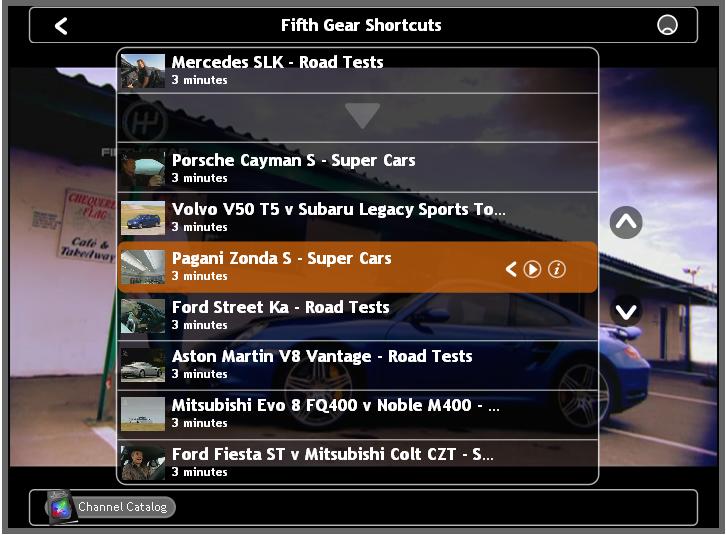
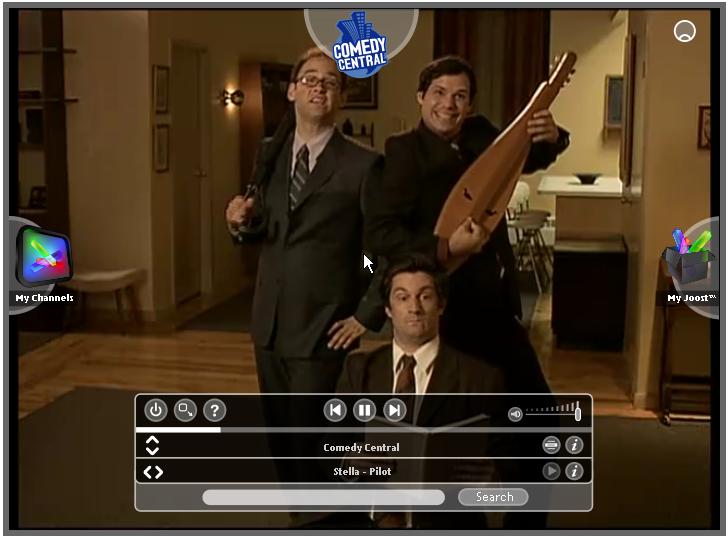
I finally got my beta account on Joost and was able to spend some time on it today. I must say that its a pretty sweet experience. The setup was painless and mature enough that anyone could do it in three clicks with no problem. The UI has this very “Web 2.0 Tivo” like experience to it. Of course, there are no edges in any of the windows and its fairly intuitive. The client is optimized for running in full screen mode. For me, this is a bit of a pain. I would prefer all the features even available in the windowed mode. In most cases, I might flip on Joost and watch it as I’m doing something else.

Much of the buzz I heard about Joost was around how similar they made the UI to actually using a TV. They came pretty close. So close, that they even have the fading white dot when you turn it off. The video steaming was smooth. Sometimes it would take a while if you’re moving to a new channel but it still comes up pretty quickly. Turning on and off the service is super responsive. I guess thats the benefits of a P2P client downloading the data in the background. At times, the service got a bit patchy, but I’m assuming that because its only a beta. Sometimes the feeds would drop out and start from the beginning.

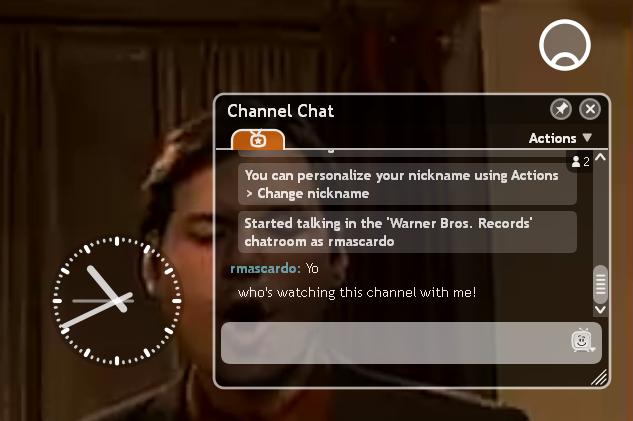
One of the cool features is their widget functionality. Just like on a Mac, you can place widgets on the “TV Screen” that do things such as chat, stream RSS feeds, etc. The available widgets are pretty limited but I’m sure this will grow over time. They can really start exploit those “TV-Web-Convergence” features everyone has been talking about for years.

What I didn’t see was the ability for user to upload content. I wonder if they will just relay on agreements with the content owners.

Good job Joost.
joost4.jpgjoost3.jpgjoost2.jpgjoost1.jpgjoost5.jpgjoost6.jpg

joost.jpg


Conversation with Russ Daniels (CTO of HP Software)

5 04 2007

One of the benefits of working for HP includes access to high power software executives. This past week I had an opportunity to have lunch with Russ Daniels, the CTO of HP Software. Or more specifically,

Russ Daniels is vice president and chief technology officer of the Strategy and Technology Office within HP’s software business, where he sets and coordinates the technology strategy across HP’s software portfolio of solutions for the Adaptive Enterprise – HP’s vision of an organization in which business and IT are synchronized to capitalize on change.

Russ happens to be my “HP Buddy”. The “HP Buddy Program” is a way for newly acquired Mercury employees to better assimilate to the “HP Way”. Seemingly useful in theory, yet practically hasn’t translated very well. Russ on the other hand, seems to understand very well the gap between theory and practicality. I found him to be smart, very down to early and genuinely interested in driving through technical issues. Our conversation went right into topics such as effectively managing central architecture in a large organizations, approaches to integrate large products and trends in the market. He had a couple funny quotes:

  • “Whenever you think you know how big HP is, its twice that size.” — Very funny and very true. I think my HP employee number has more digits then my social security number.
  • “The culture of HP is bureaucratic, yet lacks process.”

I’m looking forward to seeing him take a larger role in the new HP Software engineering organization.